-
dataValue and serializedValue in OpenAPI 3.2
31 August 2026
Read moreBest practice in APIs always includes the advice to include examples. In older versions of OpenAPI (3.1 and earlier), that was simple for JSON data but a little bit unclear for other formats whether to describe the data structure or to show the actual data that would be transferred. Help is at hand in OpenAPI 3.2 where the new fields dataValue and serializedValue mean you can do whichever makes most sense - or both!
-
Tag Kinds in OpenAPI 3.2
08 December 2025
Read moreOpenAPI tags have always been annoying: user-supplied arbitrary data for endpoints should be a fabulous feature - but the documentation tools seem to think that tags are only for them so it becomes more difficult to use tags for other purposes. In fact it is very useful to be able to tag endpoints with lots of different categories of data and so in OpenAPI 3.2, tags were enhanced to include an additional "kind" field so that different kinds of tag could be used.
-
Nested tags in OpenAPI 3.2
04 December 2025
Read moreOpenAPI has always had support for simple tags, but the OpenAPI 3.2 release brought in some serious tag upgrades including a summary field, a "kind" field with registry, - and the ability to nest tags which is the focus of today's post. If one level of organisation isn't enough for your API (and on bigger APIs I'd argue it shouldn't be) then the ability to indicate which tag is the parent of this tag will be a good feature to adopt when you upgrade your OpenAPI descriptions.
-
API Specificity with Overlays and Enums
21 July 2025
Read moreThe more I work on API standards, the more I realise how few teams understand that they can adopt the standards and, without breaking any contract, adapt them to make a strong interface for their own application. One of my favourite examples is to add enums where a standard interface cannot dictate the exact values, but in your own implementation it is very helpful to do so.
-
Right-Size Your RESTful API: More Flexibility Without GraphQL
26 March 2025
Read moreIf you publish a RESTful API and there are situations when you need less (or more!) detail in the API responses from your API - then this post is for you. When I run into this with the teams I advise, the initial problem statement usually arrives more like "We need to move to GraphQL", but this is a solution, not a problem to solve. The problem usually turns out to be either or both of:
the API responses are simply too large for some of the clients or uses cases, users need to select just the fields they want
the API doesn't have enough information in the response payload for this client or use case, users need to choose to include nested data
GraphQL is one way to achieve these things, but this post is about the RESTful way to provide the right level of detail in an API response.
-
Markdown/Mermaid output for OpenAPI Arazzo
12 March 2025
Read moreAPI reference documentation changed the way we built integrations, and eventually became part of the driving force for OpenAPI adoption and all the good tooling that flowed from it. As a developer experience specialist, I spend a lot of time thinking about how human users can work with the technical …
-
From HTTP to OpenAPI with Optic
17 February 2025
Read moreI've been using Optic's CLI, an OpenAPI tool that does a bunch of things including diffing OpenAPI descriptions and comparing HTTP traffic with OpenAPI. My use case was an established API that didn't have an OpenAPI file yet - using Optic we could create one as a starting point, and then move to a design-first workflow to make the changes that I was there to help with. For this blog post, I've used the example of https://api.joind.in as an excellent representation of an API still in use, but without an OpenAPI file and not built with code that a code generator would recognise.
-
Preview OpenAPI as HTML using Scalar
14 February 2025
Read moreThe API DevTools space is alive and well with lots of new and exciting products popping up all the time. I've been especially impressed by the new tools in the docs space, but some of the options are less practical for use as quick human-friendly OpenAPI renderings or previews to use during API development. My current favourite in this space is Scalar because I can get an HTML file to easily include in a build or share with others. It's a bit of a hack though, so I thought I'd share...
-
Save edits to OpenAPI as an Overlay
09 January 2025
Read moreFor teams that generate OpenAPI from their codebase, there's a tough choice between maintaining rich and extensive content such as Markdown descriptions and examples in codebase annotations, or in making those changes to the generated file - and then losing them when the code changes and the file is regenerated. The new OpenAPI Overlay Specification defines a format for storing updates to an OpenAPI document, and there's a new generation of tools to make it easy to do, so let's take a look.
-
OpenAPI Overlays to avoid API oversharing
12 December 2024
Read moreMost APIs aren't perfect. By design they are long-lived and may serve many audiences. I see a lot of organisations maintaining multiple versions of APIs, or simply not documenting some of the endpoints to avoid them being included in the published documentation and confusing users. The problem of API redaction is a real one in most organisations, and it goes unsolved or is solved in a way that causes ongoing friction. I've helped a few API projects to solve this problem with the new OpenAPI Overlay specification so I thought I'd share!
-
Open Standards for APIs
09 October 2024
Read moreI work or have worked with APIs of all sorts of standards, sometimes many standards at once - or none. Each standard exists for a purpose and might be a great fit, or a terrible fit for other purposes. Today's post is a recap of some of the common API standards around and what you need to know about each one.
-
Lint APIs with Redocly CLI
05 August 2024
Read moreAPI governance needs good tooling, and rules that fit - so today's post covers both.
Fun fact: I work at Redocly and had used the tool for years, but recently realised that I have a post about a different tool in the archives of my blog, but no Redocly post. So here's the Lorna-recommended version of OpenAPI linting with Redocly CLI.
-
API Description Pipelines
18 June 2024
Read moreWorking on API tools, I get to see inside lots of different organisations' API projects and processes. Every scenario is different, but a common theme is that many companies use a more complicated API description workflow than you see in conference slide decks! This article shares my typical workflow, steps and chosen tools that might show up in an API description pipeline.
-
API Linting Levels
11 January 2024
Read moreI've been thinking about API linting lately, partly because I work on a tool for API linting in my day job, and partly because I get quite a lot of questions from teams wanting to improve their API quality. The "best" ruleset depends entirely on your context, where you are in your API practice journey, and how much you want to invest in the API in question. I typically use a 4-levels model of API linting readiness, and I'm sharing them so that you can find yourself on the map and see where you might go from here.
-
Add OpenAI flags to OpenAPI descriptions
28 November 2023
Read moreWith OpenAI's new Actions feature allowing you to get a GPT that uses your own API, many new doors are open. However giving an AI an access token the keys to your API and telling it to have fun may lead you to realise that one of the doors available leads to the empty lift shaft of overwritten data, or the bottomless well of cloud bill shock. To reduce the risks, OpenAI supports an extension x-openai-isConsequential that you can add to your OpenAPI description, to indicate which endpoints should not be called without a human confirmation step.
I'm not doing much with OpenAI right now, but I do plenty with OpenAPI and the question "how do I add this field to my existing API description?" is one that I can answer! What's more, you can use the advice in this post to add other extensions or additions to your OpenAPI descriptions using Overlays, this advice isn't OpenAI-specific, but it's used in the examples.
-
When to version bump your OpenAPI description
20 November 2023
Read moreI've heard a variety of bad advice (and some untruths!) regarding how to version your OpenAPI description lately. Rather than dig into those, instead I'll share my opinion on how I like to version API descriptions in my own projects. Every API project is different, but perhaps there's something here that can help your project too.
-
Visualise OpenAPI with Blockly
20 June 2023
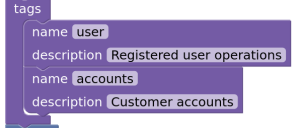
Read moreGiving talks about OpenAPI often means lots and lots of slides of YAML. In fact, one of my talks even contains a "warning, contains yaml" slide! If you aren't a professional yaml developer, it can be difficult to digest and learn from, and so I wanted to do better. The various elements are nested inside one another, and so I had this idea to build a representation of OpenAPI using Blockly (the tooling also used for Scratch, if you've seen that).
-
Tips for better documentation with OpenAPI
12 June 2023
Read moreI love documentation, which is supposed to be rare for software engineers. I am pretty sure that loving documentation is actually very common, but not very cool and so few people admit to it! I love reading good docs, and so I love writing them too. Between hanging out in the Write the Docs community, and recently being at the APItheDocs conference, I've answered a bunch of questions about getting good documentation from an OpenAPI document, so I thought I'd round them up in case it's useful.
-
Improve Existing OpenAPI Descriptions
28 February 2023
Read moreI'm a firm fan of a design-first approach to building APIs, and advocate for it at every opportunity. Repeatedly. Design-first means that an API change starts in the OpenAPI description, gets reviewed and approved by the stakeholders, and then gets built afterwards.
I also live in the real world, where OpenAPI descriptions get generated from existing codebases, and engineering teams lack either the knowledge or the enthusiasm to modernise their processes. With a generated OpenAPI description, everything else that OpenAPI enables is likely to be disappointing, because the description only contains the information that was in the serverside code, and if you're lucky some comment metadata. Enter OpenAPI Overlays, a way to describe alterations to an existing OpenAPI description that can be reapplied every time that description changes.
-
What's New in OpenAPI 3.1
14 December 2020
Read moreWith OpenAPI 3.1 coming "soon", I gave a talk at APIDays Paris about what to expect. But I'm a great fan of the written word as reference so here's a written recap of what's in the next OpenAPI release.
Top features:- Compatible with JSON Schema 2020-12- Webhook support- Many other minor improvements -
Creating a Simple OpenAPI Spec
06 August 2020
Read moreHaving API descriptions in your workflow is a game-changer, but how do you get from nothing to a functioning spec in the first place? I recently made a very simple spec for a very simple API, and thought it might make a good example for anyone looking to create a spec for the first time. OpenAPI specs are very verbose so this very tiny API makes quite a manageable example!
-
Custom OpenAPI Style Rules with Spectral
21 May 2020
Read moreEdit: There's a newer post on this topic using Redocly CLI.
I work quite a bit with OpenAPI specs and with lots of specs and lots of collaborators, keeping the specs all functional (never mind tidy, consistent, or other dreamwords) is a challenge! We use spectral to check our specs, both when we work on them and in the build process. Spectral is great but it has Opinions(TM)!
For most users, running Spectral out of the box gives quite a lot of output even on an otherwise valid spec. I do think the default ruleset for Spectral is pretty good, but every situation is different so having your own ruleset to use is a good idea. This post shows how to use a ruleset and some examples.
-
Teach Your API Test Platform to Send Callbacks
18 February 2020
Read moreI already wrote about using Prism as an API test platform but I didn't include an example with callbacks so this post is to fill that gap! If you didn't read the previous post, the tl;dr is that Prism is a nodejs open source tool that can take your OpenAPI specification and then do an impression of your live API, validating the API calls sent to it and responding with the example data described in the spec. It can also follow up the API response and send an HTTP request of its own to mock the callbacks described in your OpenAPI spec.
-
Instant Test API Platforms with Prism
23 January 2020
Read moreI've been writing a bit about OpenAPI lately and I realised that I didn't share how I'm creating local, test versions of production APIs to work with while I develop new client code or test SDK features. The recipe is simple: you will need an API spec, the excellent open source tool Prism and an HTTP client. Mix it up and be ready to change your API development workflows forever.
-
OpenAPI Description using API key and secret
15 August 2019
Read moreI've been working on a few OpenAPI descriptions of APIs lately, and really enjoying the benefits they bring. In particular the ability to import into Postman as a collection I think is a "killer feature" for APIs looking to get developers up and running quickly. The catch? I found that an API that needs an API key and secret, or a username and password/token, is supposed to be described with multiple security schemes - but this does not play nicely with tools like Postman.
-
Using Tags in your OpenAPI Spec
26 February 2019
Read moreWorking with OpenAPI is bringing so many possibilities to the way that developers work with APIs, it's exciting! The spec is very comprehensive though and I've found myself answering questions on individual aspects of it recently, so I thought I'd capture one or two of those things here. Today: tags.
-
Ready-to-wear API Collections with OpenAPI and Postman
08 January 2019
Read moreHave you noticed that API providers are starting to offer "descriptions" of their APIs? These are usually OpenAPI specifications, computer-readable documents that describe every aspect of an API's endpoints. They can be used to generate documentation, SDKs, but now they can also be used for my favourite API-related activity: poking around! Postman just added a feature to allow importing OpenAPIs and I love it.
-
Generating PHP library code from OpenAPI
20 November 2018
Read moreI'm working with a bunch of OpenAPI specs now I am working for Nexmo and so far I'm loving working with API descriptions. OpenAPI is the next iteration of what used to be called "Swagger", a machine-readable way to describe your API and from that description create docs, code libraries, tests, and all sorts. Today's post is a quick writeup of how I generated some PHP code so that I can refer back to this next time I want to do it!